The Only Winning Move:
Cybersecurity, AI, and the Future of Defense
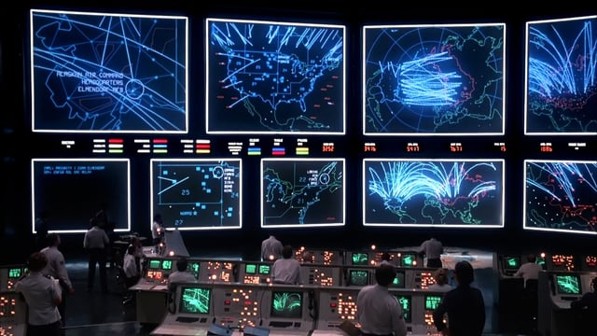
Source: Reddit / r/CassetteFuturism. NORAD Command Center from WarGames (1983).
In June 1983, a science fiction thriller called WarGames opened in theaters. Its hero, played by a young Matthew Broderick, is a Seattle high school student who uses his home computer and a telephone modem to hunt for unreleased video games. Instead, he stumbles into a military supercomputer at NORAD, the command center responsible for detecting a nuclear attack on North America.
That computer is WOPR (War Operation Plan Response), a fictional machine built to simulate nuclear war and, if ordered, to fight one. The teenager starts what he thinks is a game called Global Thermonuclear War. WOPR cannot tell the game from reality, and the world edges toward an actual launch. The crisis ends only after WOPR plays out every scenario and reaches an uncomfortable conclusion: “A strange game. The only winning move is not to play.”
The story was fiction. The reaction in Washington was not.
President Reagan watched the film at Camp David the weekend it opened and asked his national security team whether something like it could really happen. General John Vessey, Chairman of the Joint Chiefs, came back a week later with an answer: “Mr. President, the problem is much worse than you think.” In September 1984, Reagan signed NSDD-145, the first presidential directive on computer security.
More than forty years later, the part of WarGames that has aged best is not the teenager with a modem. It is the machine: a computer that tests attacks around the clock, searches for weaknesses and makes decisions faster than any person could. Artificial intelligence is beginning to automate parts of software development, vulnerability discovery, phishing, reconnaissance and cyber defense. At the same time, modern militaries are wiring satellites, drones, sensors, weapons and command systems into software-driven networks.
For investors, cybersecurity and defense are starting to look less like two industries and more like one system.
The Fifth Battlefield
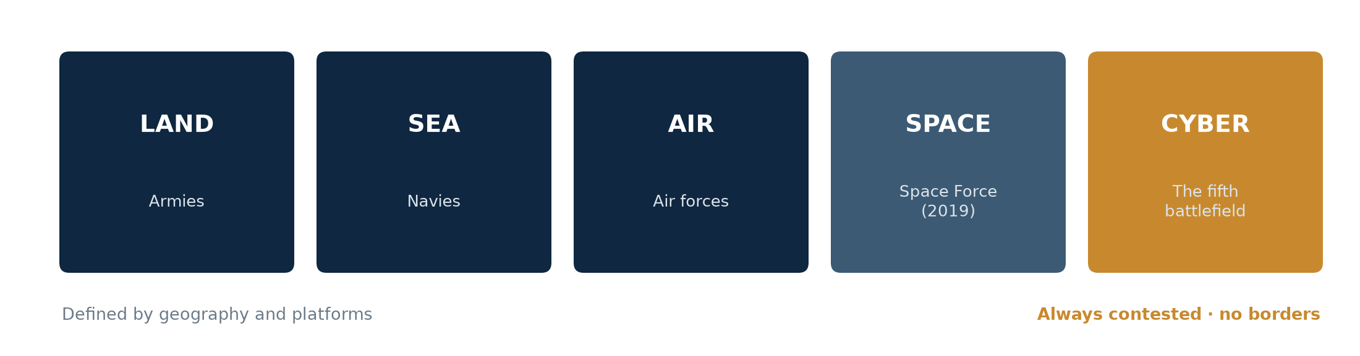
Source: U.S. Department of Defense doctrine; U.S. Cyber Command "persistent engagement" and "defend forward" strategy.
For most of history, military power was easy to picture. Armies held land, navies held the seas and air forces held the skies. Space joined the list more recently. Today the Pentagon formally recognizes a fifth domain: cyberspace.
That matters because cyber conflict breaks the old rules. An adversary does not need to cross a border to do damage. Power grids, communications networks, banks, transportation systems and military logistics can all be reached from a keyboard.
Cyber conflict also has no declaration of war and no ceasefire. It runs continuously. That reality has pushed U.S. Cyber Command toward two ideas, persistent engagement and defend forward, which mean finding and disrupting hostile activity close to its source instead of waiting for it to arrive. Think less about building a taller castle wall and more about patrolling outside it.
AI Changes the Economics of Attack
Cyberattacks have always depended on three scarce inputs: time, expertise and skilled labor. AI makes all three cheaper. It can draft convincing phishing emails, comb through code for weaknesses, automate reconnaissance and speed up parts of an intrusion. A skilled hacker who once had time to target a handful of organizations can now probe thousands.
The threat data already points that way. Microsoft says it now processes roughly 100 trillion security signals a day. CrowdStrike tracks what it calls breakout time, the minutes between an attacker’s first foothold and the move deeper into a network. Its average fell from 84 minutes in 2022 to 29 minutes in 2025. The fastest intrusion it observed last year took 27 seconds.
No human analyst responds in 27 seconds.
That is the real shift. When attackers move at machine speed, defenders have to as well. The result is a loop WOPR would recognize: machines testing machines, software hunting software, automated systems probing for weaknesses while other automated systems hunt for the intruders.
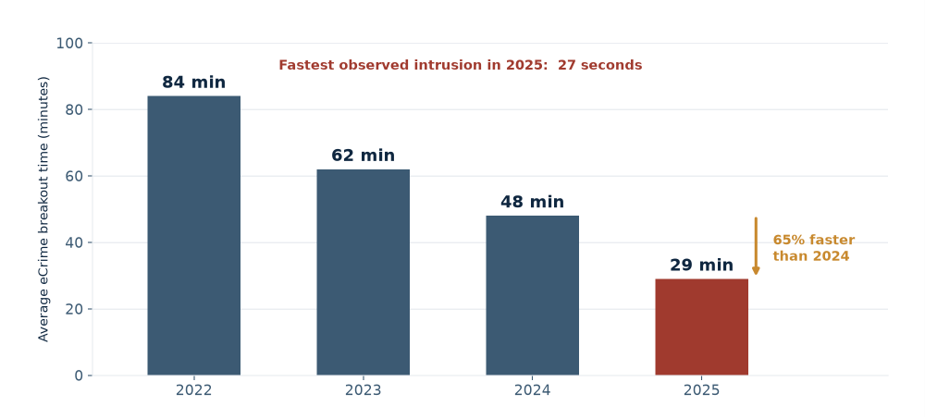
Source: CrowdStrike Global Threat Reports, 2023-2026
Defense Is Becoming Software
The same shift is happening inside traditional defense. For most of the last century, military advantage was measured in platforms. Who had the best fighter jet, the quietest submarine, the most accurate missile?
Those questions still matter, but a platform is now only as good as the network behind it. A satellite spots activity. A sensor collects the data. Software interprets it, AI flags what matters, a command network distributes it, and a human operator or autonomous system responds.
The winner is no longer the side with the best individual piece of hardware. It is the side whose whole system can see, understand and act first. Tomorrow’s militaries will still buy aircraft, ships and missiles, but those platforms will increasingly function as nodes inside much larger digital networks.
China Has Already Reorganized
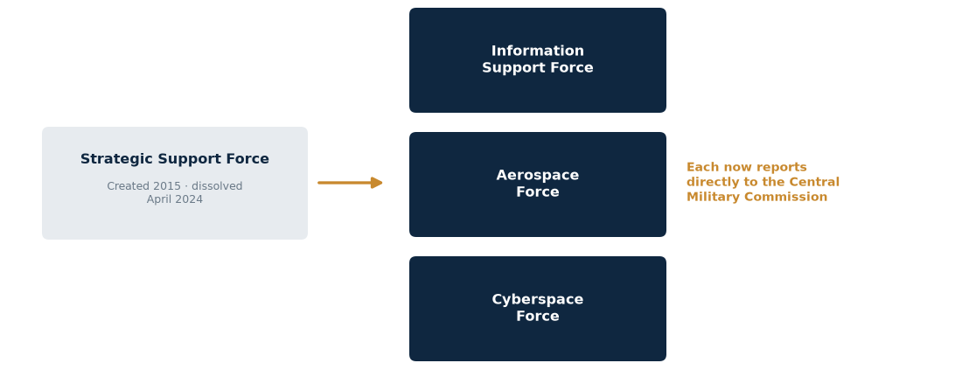
Source: Jamestown Foundation, CNA and NDU Press analyses of the April 19, 2025 PLA restructuring.
The United States is not working through this alone. In April 2024, China dissolved the Strategic Support Force of its People’s Liberation Army and replaced it with three separate branches: an Information Support Force, an Aerospace Force and a Cyberspace Force. Beijing now treats networks, cyber operations and space as core parts of modern warfare, not support functions sitting behind the tanks and ships.
Washington is having its own version of that debate. American cyber personnel are still spread across the military services, with U.S. Cyber Command directing operations. Some policymakers and national security experts argue cyber has become important enough to deserve its own branch. Others warn that a new branch would add bureaucracy without fixing deeper workforce and readiness problems.
For investors, what matters is where both camps agree: U.S. cyber capability needs to get stronger. The fight is over the org chart, not the mission.
Cybersecurity Is Becoming Infrastructure
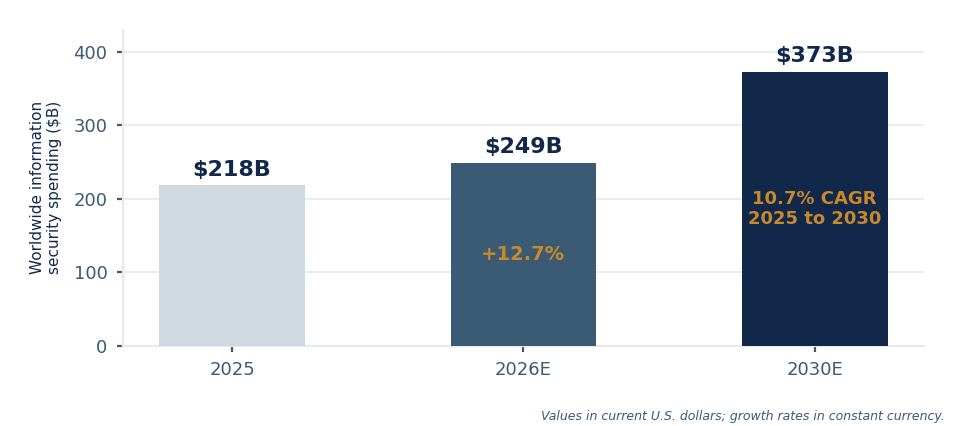
Source: Gartner Forecast: Information Security, Worldwide (Dec. 2025/Feb. 2026), via Cybernews and Software Strategies Blog
The private sector is moving in the same direction. Cybersecurity used to be filed under IT expenses. Today it looks more like plumbing or electricity: no bank, hospital, utility, cloud provider, manufacturer or government agency can realistically run without it. Gartner’s latest forecast, released in June, puts worldwide information security spending at roughly $249 billion in 2026, up 12.7%, on the way to about $373 billion by 2030. Part of that growth is simple arithmetic. Every new cloud workload, connected device, digital identity and AI system is another door someone has to lock.
That is what makes cybersecurity unusual. The same technology that makes a business more productive also makes it more exposed, so the security burden grows right alongside the technology itself.
But Not Every Cybersecurity Company Wins
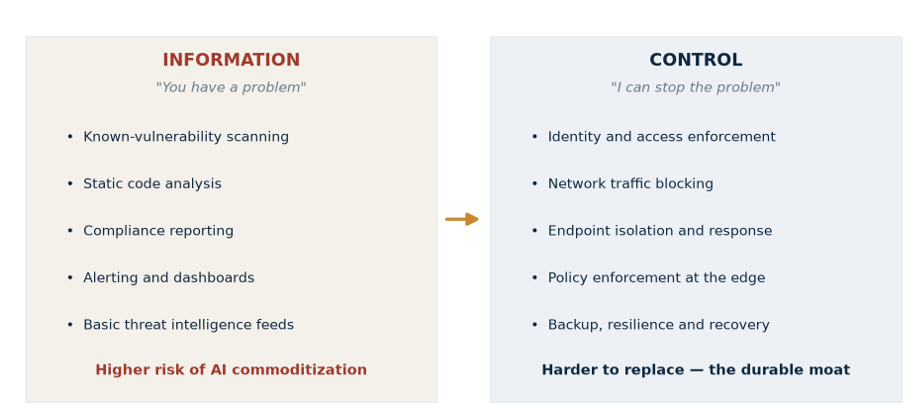
Illustrative categorization for investor framing; individual products may span both columns.
A growing market does not lift every company in it. AI may raise total demand for security while turning certain products into commodities. If an AI model can cheaply scan code for known vulnerabilities, a company charging a premium for a standalone scanning tool could face real pricing pressure.
It helps to think of cybersecurity as a stack of layers: network infrastructure, identity and access, cloud and application security, threat detection and response, and resilience and recovery. AI will not hit each layer equally.
The dividing line is between information and control. Software that tells a company “you have a problem” is the easiest to automate away. Infrastructure that can block traffic, verify an identity, isolate a compromised device, enforce policy or restore systems after an attack is much harder to replace.
The question is not who sells cybersecurity. It is who owns the control point.
The New Defense Ecosystem
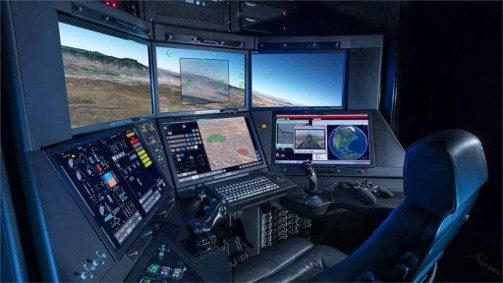
Source: General Atomics Aeronautical Systems, Inc., via Unmanned Systems Technology
Step back far enough and several investment themes start to merge: cybersecurity, artificial intelligence, cloud infrastructure, data analytics, networking, satellites, autonomous systems and traditional defense. Palantir is classified as software, CrowdStrike as cybersecurity, Fortinet as network security and Lockheed Martin as aerospace and defense. Yet a modern military or intelligence operation may rely on all of those capabilities, or on companies performing similar functions, working as a single system.
A more useful map ignores the industry labels and follows what a modern military actually does:
- Sense. Satellites and sensors gather information.
- Connect. Networks move it.
- Compute. Chips and data centers process it.
- Decide. AI and software help interpret it.
- Act. Weapons and autonomous systems respond.
- Protect. Cybersecurity guards every link in the chain.
Looking Past the Hardware
The investment opportunity in defense extends beyond traditional contractors. We believe some of the most compelling areas may sit behind the hardware: cybersecurity, software, data, semiconductors, communications, cloud infrastructure, and the systems that connect and protect modern military operations.
We are not simply asking who builds the jet, ship or missile. We are also looking at who powers the computing, secures the network, analyzes the data, connects the battlefield, and protects increasingly digital defense systems. In WarGames, the computer concludes that “the only winning move is not to play.” In cybersecurity, there is no such choice. Governments, companies, and militaries are already in the game, and technology is becoming as critical to defense as the physical weapons themselves.
The battlefield is becoming more digital, defense is becoming more technological, and we believe the investment opportunity increasingly extends to the infrastructure behind it.
Principle Wealth