How to Win Friends and Influence People in the Attention Economy
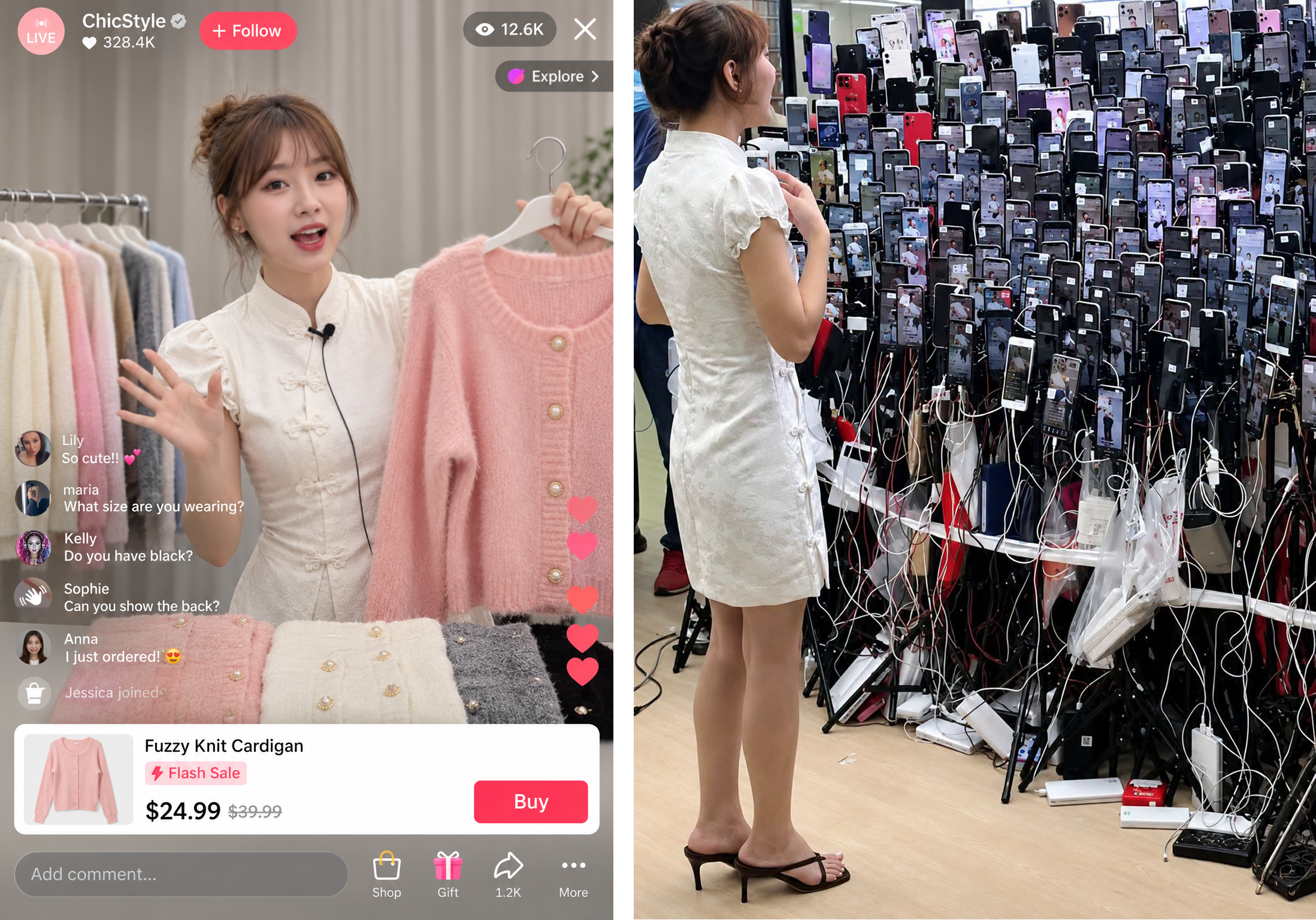
Source: TikTok/ChicStyle - Behind-the-scenes footage shows just how many phones an online influencer films on to post fashion videos across different platforms.
In 1936, Dale Carnegie published How to Win Friends and Influence People. His central argument was disarmingly simple: the fastest way to earn someone’s interest is to show genuine interest in them. Ask questions. Listen more than you talk. Make the other person feel important.
Ninety years later, one of the fastest-growing industries on earth runs on the opposite idea. The goal is no longer to be interested in other people. It is to get as many people as possible interested in you.
That is the business model behind social media. Instagram, TikTok, and YouTube are free to use because the people scrolling are not the customers. Advertisers are. What the platforms sell them is our time and attention, measured in minutes spent on the app and ads seen along the way. The longer we stay, the more they earn.
Influencers are the most visible part of this system. They are the creators, YouTubers, and streamers who have turned being watched into a career, and in a few cases into a billion-dollar company. Their income depends on the same thing the platforms want: our eyes on the screen. Together, the platforms and the people who perform on them make up what has become known as the influencer economy.
Carnegie’s formula for influence was “be interested.” The modern formula is “look at me.” In this issue, we look at what that trade is worth, who profits from it, and what it is quietly costing the rest of us, in dollars and in hours.
Fame Is Now a Business Model
Goldman Sachs Research projected that the creator economy could roughly double in size to $480 billion by 2027 from $250 billion in 2023. Brands are following the eyeballs. eMarketer reports that U.S. influencer marketing spending surpassed $10 billion in 2025, reaching around $10.52 billion. Jimmy Donaldson, better known as MrBeast, became the first creator to reach 500 million YouTube subscribers in June 2026. In January, his company, Beast Industries, raised $200 million from Bitmine at a $5 billion valuation.
Brothers Jake and Logan Paul, who rose to fame as YouTube personalities, proved that attention can be converted into almost anything. Jake Paul’s 2024 fight against Mike Tyson garnered an estimated audience of 108 million live viewers globally, making it the most-streamed sporting event in history. Logan Paul and fellow YouTuber KSI parlayed their followings into Prime Hydration (an electrolyte drink similar to Gatorade), which hit $1.2 billion in sales by 2023.
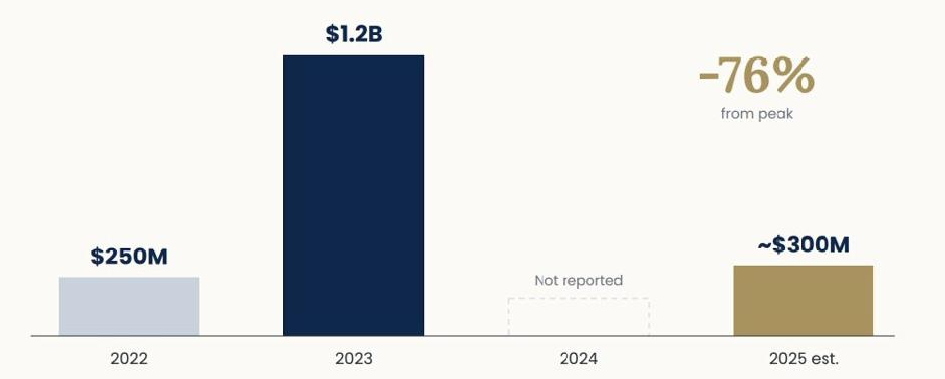
Prime Hydration annual sales, co-founded by Logan Paul and KSI.
Source: Prime first-year retail sales (2022) and 2023 sales per Bloomberg; 2025 estimate per Forbes. 2024 global figure not publicly reported.
Two years later, the attention had moved on. Forbes reports that Prime Hydration’s estimated revenue fell to about $300 million in 2025, roughly 76% below its peak. One of its own suppliers blamed the slide on “fading social media buzz” in a lawsuit.
Most creators never come close to these numbers. Goldman Sachs found that only about 4% of global creators pull in more than $100,000 a year.
Meanwhile, the platforms are starting to pay a price. In August, Meta agreed to settle claims that it designed Instagram to be addictive and misled the public about harms to young users. The headline figure is $12.19 billion over 10 years, an amount that rises to $17.1 billion if TikTok, YouTube and Snapchat agree to comparable terms.
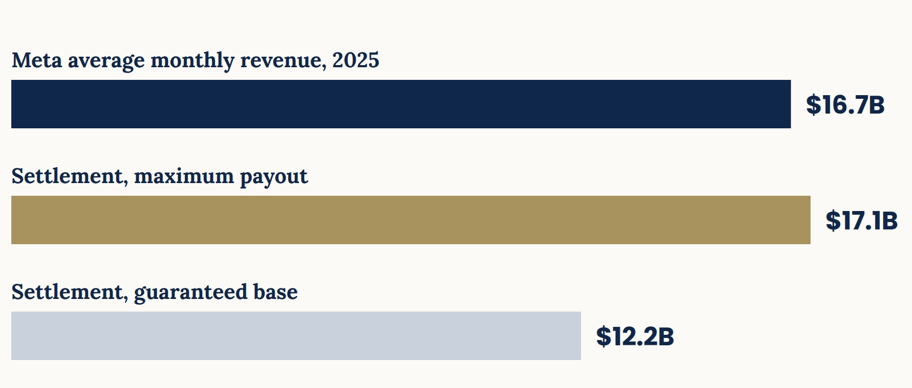
Sources: Meta Platforms FY2025 revenue of $200.1B (Form 10-K), divided by 12; settlement terms per Connecticut Attorney General and multistate AG announcements, August 2026. Base paid over 10 years.
The settlement has a Connecticut fingerprint. Connecticut will receive up to $265.4 million, and the settlement also resolves the multistate investigation led by Connecticut into Meta’s sharing of nonpublic Facebook user information with third parties like Cambridge Analytica. Attorney General William Tong said Meta “strip-mined the souls of America’s children” for profit.
For perspective, Meta’s global revenue reached $200.1 billion in 2025. The largest single-defendant settlement in American history amounts to roughly one month of sales.
The Highlight Reel Problem
On social media, we share the highlights: the dream vacation, the big promotion, the beautifully renovated kitchen, the picture-perfect pose, and the perfectly plated dinner. What we rarely see are the moments behind the scenes: the argument in the car on the way to the airport, the dirty dishes piled in the sink, or the countless late nights, hard work, and stress that went into making those picture-perfect moments possible. The result is a quiet distortion. We measure our everyday lives against everyone else’s best moments, and we come up short every time.
The U.S. Surgeon General’s advisory found that children and adolescents who spend more than 3 hours a day on social media face double the risk of mental health problems, including symptoms of depression and anxiety. Nearly half of teens, 46% of adolescents aged 13 to 17, said social media makes them feel worse about their bodies.
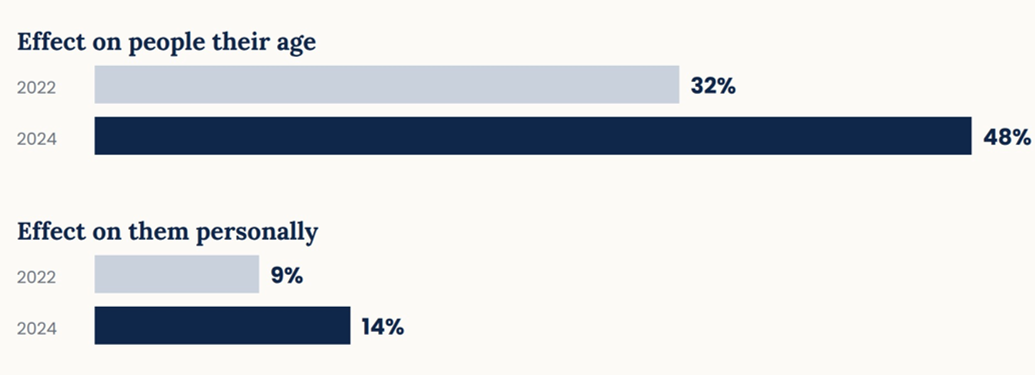
Share of U.S. teens who say social media has a mostly negative effect.
Source: Pew Research Center, "Teens, Social Media & Mental Health" (April 2025). Surveys of U.S. teens ages 13 to 17 conducted in 2022 and fall 2024.
Among the reforms required by the settlement, Meta must limit certain social-comparison features, including beauty filters and visible “like” counts.
When a company agrees to hide the scoreboard, it tells you something about the game.
The Least Social Era in Social History
The Bureau of Labor Statistics’ American Time Use Survey shows how much our habits have changed. In 2003, Americans ages 15 and older spent an average of 47 minutes per day socializing face-to-face. By 2025, that had fallen to just 35 minutes, a 26% decline.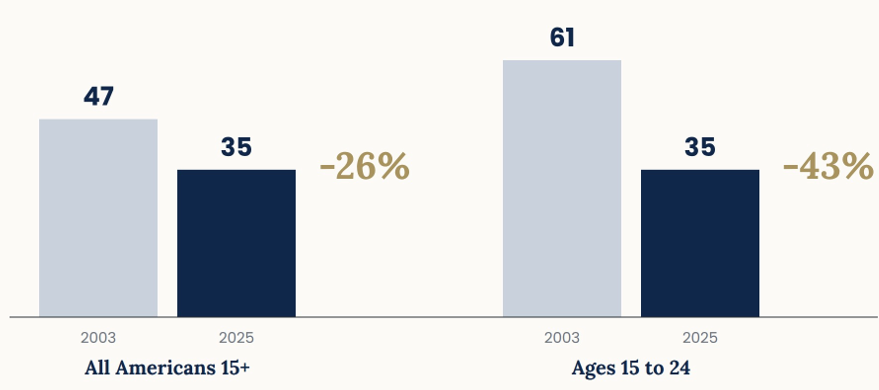
Average minutes per day spent socializing and communicating in person.
Source: U.S. Bureau of Labor Statistics, American Time Use Survey (2003, 2025). 2025 estimates exclude Oct. 1 to Nov. 12, 2025, when survey operations were suspended.
The drop among young people is steeper. Americans ages 15 to 24 went from 61 minutes per day socializing to just 35, a decline of 43%. Remarkably, Americans aged 55 to 64 now spend more time hanging out than teenagers.
Meanwhile, the average social media user spends 2 hours and 21 minutes per day on social platforms, per DataReportal and GWI. That is roughly four times the time the average American spends socializing in person.
UC Irvine researcher Gloria Mark has tracked how long people stay on a single screen before switching. In 2004 her team measured 2½ minutes. Today the average is 47 seconds. And once diverted from a task, people take about 25 minutes to refocus on it.
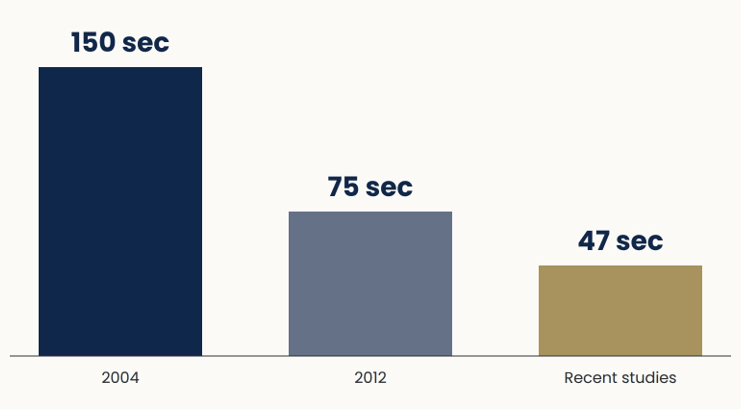
Average time spent on one screen before switching to another.
Source: Gloria Mark, Ph.D., University of California, Irvine, Attention Span (2023). Recent figure reflects studies from roughly 2026 onward.
The irony writes itself. We have become less social in an increasingly “social” world.
Attention Has a Market Price
For investors, the attention economy is not a cultural curiosity. It is one of the largest profit pools in the market, and it has a measurable unit price. Meta’s annual worldwide average revenue per person in 2025 was $57.03, an increase of 15% from 2024. That is, in effect, what a year of one person’s attention sold for. Three dynamics stand out as we look ahead.
- Attention concentrates, but it does not stay loyal. Prime’s rise and fall shows how quickly audience-driven demand can evaporate when the buzz fades. Durable value tends to sit in operations, distribution, and products people buy again without being reminded.
- The regulatory bill has arrived, and it is a template. The settlement’s structure is telling: a contingent $5.3 billion is released only if YouTube and TikTok adopt equivalent safety features and each makes a matching payment. Regulators are designing for the whole sector, not one company. Meta itself expects to accrue a legal expense of approximately $10 billion in the third quarter of 2026.
- The money keeps flowing anyway. eMarketer projects U.S. influencer spending growth accelerating to 15.7% in 2026. Advertisers are voting with their budgets that attention remains worth buying, legal headwinds and all.
The Cost of Looking
The more time we spend looking at others, the less time we spend looking at and working on ourselves. At 2 hours and 21 minutes a day, the average social media user spends roughly 858 hours a year scrolling. That is about 36 full days. Every year.
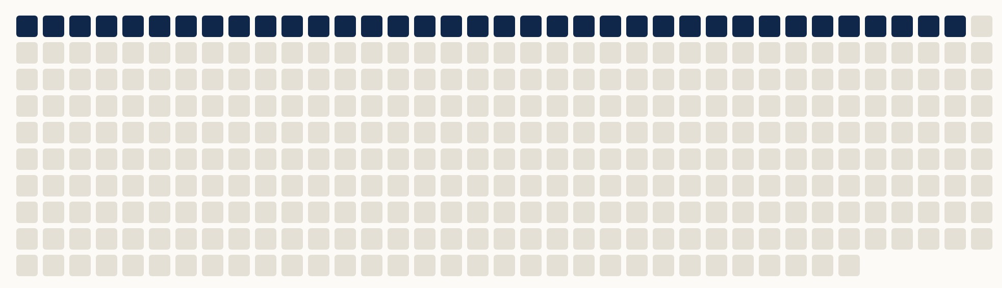
At 2 hours and 21 minutes a day, that is about 858 hours a year. Each square represents one day.
Source: DataReportal / GWI, Digital 2026 (average daily time on social media). The annual total is a Principle Wealth calculation: 141 minutes x 365 days.
In our work, we think constantly about opportunity cost. Every dollar spent is a dollar that will never compound. Time follows the same rule, with one important difference: you cannot earn more of it. What could 36 days compound into? A new language. A business plan. A standing Thursday dinner with the friends we keep meaning to call. Conversations with your children.
Carnegie argued that you will make more friends in two months by taking an interest in others than in two years of trying to get them interested in you. The influencer economy has spent billions trying to make us forget that.
Principle Wealth