America’s Exceptionalism, 250 Years and Counting
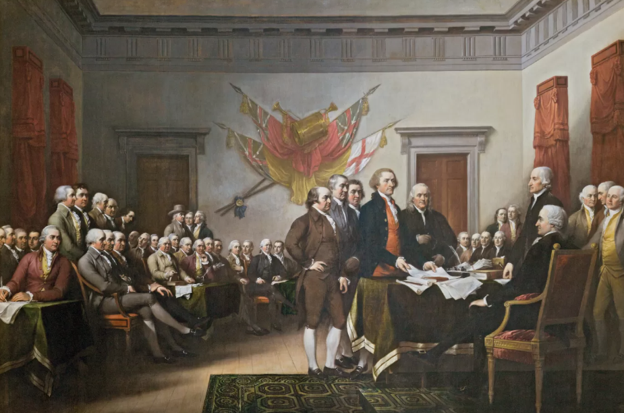
Source: JohnTrumbull, Declaration of Independence, oil-on-canvas.
On July 4, 2026, the United States will commemorate the 250th anniversary of the signing of the Declaration of Independence. The milestone is more than a birthday. It is a time for reflection: What made America unusually capable of growth, and what must be renewed so the next generation inherits the same possibility?
American exceptionalism is often mistaken for self-congratulation. At its best, it is something more demanding: a belief that a free people, governed by institutions that can be improved, can convert difference into dynamism, ambition into innovation, and abundance into opportunity. The claim is not that America has been without failure. The claim is that America has repeatedly found the will and the mechanisms to repair, reinvent, and widen the promise of self-government.
A Promise That Became an Economic Engine
The Declaration began as a political act. Over time, its animating premise, human liberty, consent of the governed, and the pursuit of happiness, became a civic standard against which each generation could measure itself. That standard is part of the country's exceptional character: America was not founded on a single bloodline, language, or ancient dynasty, but on an argument about rights and human possibility.

Source: Alamy
The United States began as a largely agrarian nation and became a leading global economic power through a commitment to free-market capitalism, constitutionally protected property rights, and innovation. From its founding, the rejection of mercantilist controls drove extraordinary growth and enabled the US to outpace its contemporaries. By the 1920s, America had become the global leader in the production of steel, automobiles, electricity, and consumer goods. Innovations such as Henry Ford's assembly line slashed production times and prices, creating more democratized and affordable products for consumers.
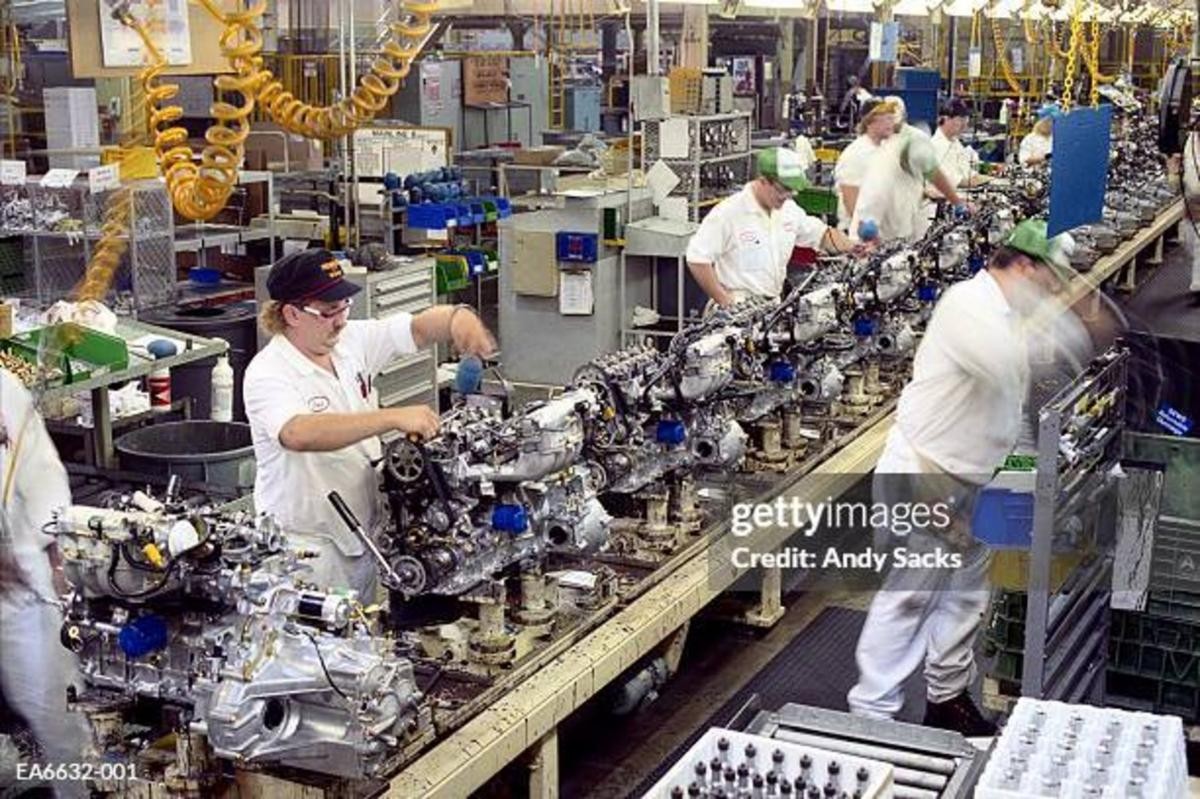
Source: Andy Sacks, Gettyimages
McKinsey Global Institute frames the 250-year arc as four waves of competitiveness: agricultural abundance, industrial scale, scientific leadership, and digital dynamism. The sources of advantage shifted, but the recurring pattern was consistent: disruption forced reinvention, and reinvention strengthened the country. The constant ingredients were not mysterious. America combined a vast natural endowment, land, energy, waterways, and a continent-sized market, with an entrepreneurial culture that rewarded risk-taking and practical problem-solving.
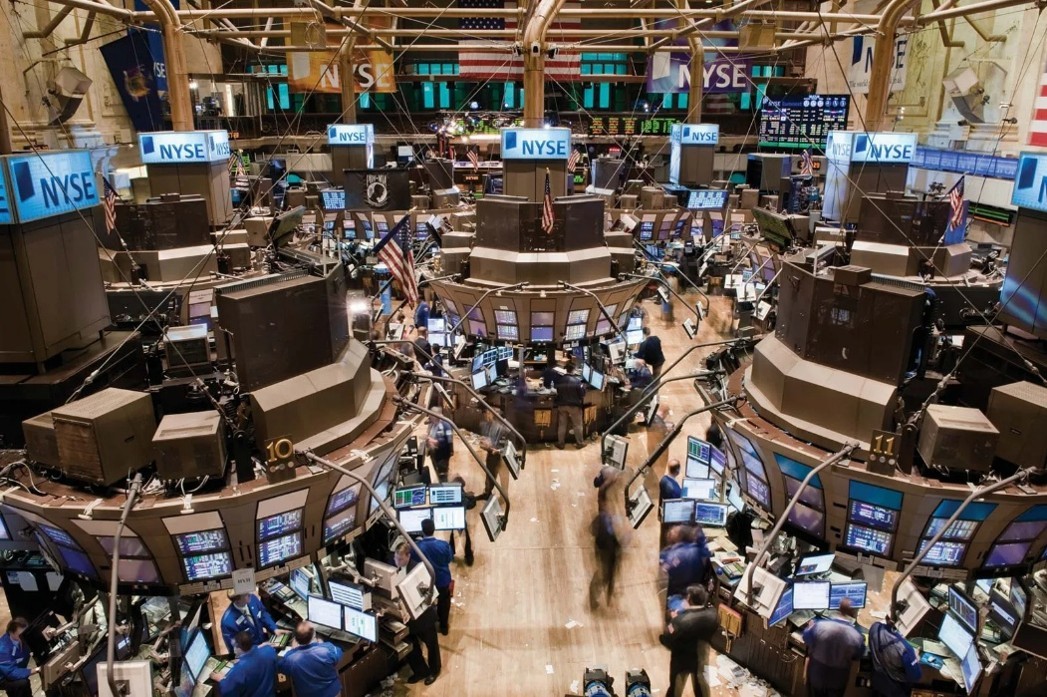
Trading floor of the New York Stock Exchange, New York City. Source: Justin Guariglia—xPACIFICA/Redux
World War II proved to be the inflection point that no economic model could have predicted. While Europe and Asia rebuilt from rubble, the American industrial base emerged intact and supercharged. Between 1945 and 1973, GDP grew at an average annual rate of 3.8%, labor productivity rose 2.5%, and wages rose roughly 2.2%.
The United States played a pivotal role in rebuilding war-torn regions and helped establish an international order that governed global relations for decades. The US leveraged the status of the dollar as the world's reserve currency, its strategic geopolitical influence, and a thriving entrepreneurial ecosystem to shape international norms and the global economic framework. The ability to issue the world's reserve currency, meant that the US could borrow cheaply, run persistent trade deficits, and finance consumption and innovation at a scale no other nation could match. It was structural, not accidental.
The Edge Today: Scale, Science, and Speed
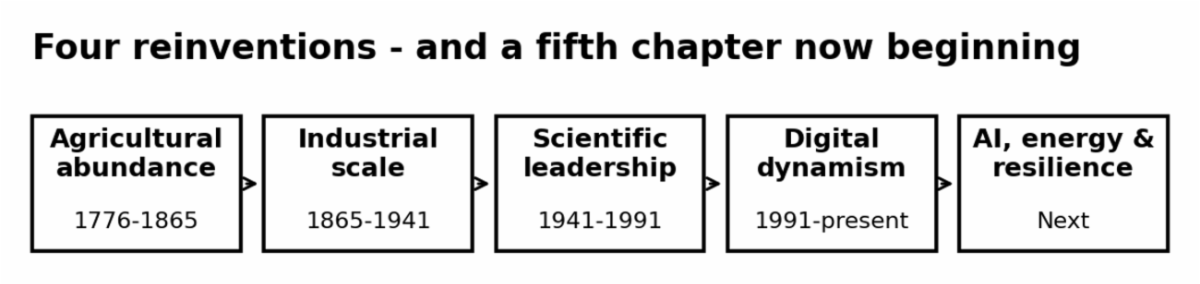
Source: McKinsey Global Institute, March 2026.
The United States enters its 250th year with remarkable advantages. McKinsey estimates that the country has roughly 4% of the world's population but generates 26% of global GDP, spends 27% of the world's Research and Development (R&D) dollars, accounts for 51% of notable AI models, and is home to 59 of the world's 100 largest firms by market capitalization.¹
Other sources reinforce the point. The World Bank lists US GDP at $28.75 trillion in 2024 and GDP per capita at $84,534.² The National Science Foundation reports that US R&D performance totaled $937 billion in 2023, with a 2024 estimate of $993 billion.³ Stanford's AI Index reports that US-based institutions produced 40 notable AI models in 2024, well ahead of China's 15 and Europe's 3.⁴
The American economy has been the world's largest since the 1870s and has been outperforming its developed-market peers for decades, with real GDP growth averaging 2.25% per year since 1990, compared with 1.7% in the UK, 1.4% in France, and 0.7% in Japan. The US is the only economy that ranks in the world's top five on measures of GDP, financial market depth, and technological innovation simultaneously. It is from this combination that America derives its global economic and market heft.⁵
The AI Infrastructure Lead
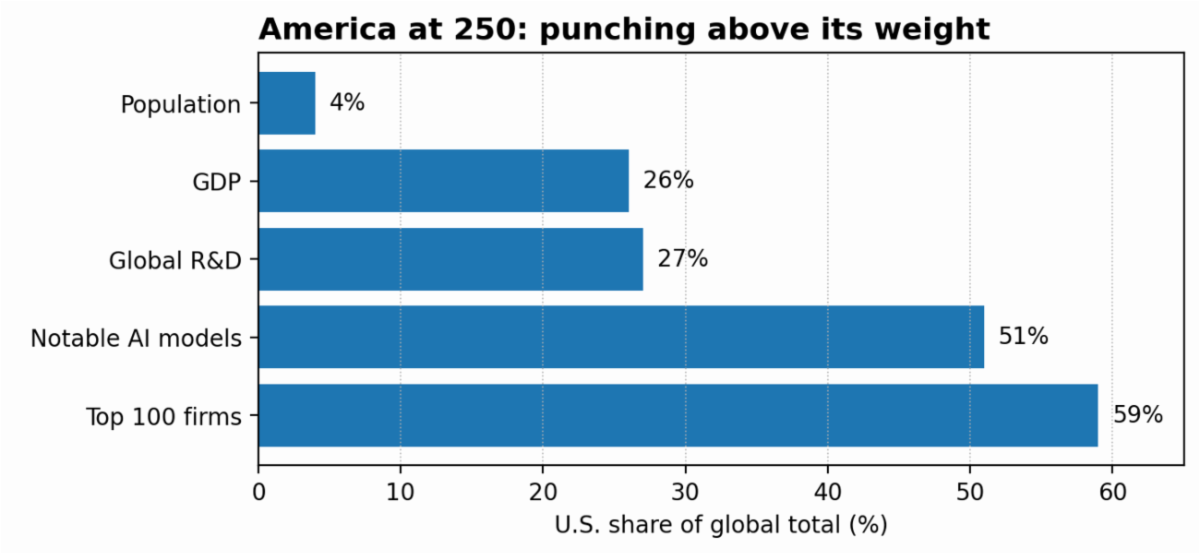
Source: McKinsey Global Institute, "At 250: Sustaining America's competitive edge," March 2026.
The technology lead is striking. From 2013 to 2024, cumulative private AI investment in the United States exceeded $470 billion, compared with roughly $50 billion across EU countries, $28 billion in the UK, $15 billion in Canada, and $6 billion in Japan.⁶ That gap did not narrow in 2025. It widened. A total of $159 billion, representing 79% of global AI funding, went to US-based companies in 2025, with the San Francisco Bay Area alone attracting more than three-quarters of that total.⁷
The United States dominates cumulative AI supercomputer capacity, controlling an estimated 74% of global high-end AI compute, while China holds 14% and the EU holds 4.8%.⁸ Capital expenditure among leading US technology firms more than doubled over the last two years, reaching $427 billion in 2025, with projections pointing to a further 30% increase in 2026.⁹
These numbers matter not as trophies but as capacity. They describe a system that can finance risk, attract talent, scale ideas, and recover from mistakes faster than most rivals. America's edge is not simply that it has large companies or research budgets. It is that capital, talent, customers, universities, public science, and business ambition can collide at unusual speed.
US household wealth stands at over $176 trillion, equivalent to more than 570% of GDP. Plaining put, the United States has accumulated so much private wealth, in homes, retirement accounts, stocks, and businesses, that is adds up to more than five and half times the entire economic output the country produces in a year. This only adds to the support for the country remaining the primary destination for global savings, with the dollar's dominant reserve role underpinning structural demand for US Treasuries.¹⁰
The Responsibility of Exceptionalism
A country can lose an advantage by assuming it is permanent. McKinsey warns that some historical strengths can become liabilities: deteriorating fiscal health, eroding infrastructure, declining educational achievement, fading manufacturing know-how, and sustained disparities in income and wealth. Those are not abstractions. They shape whether families can advance, whether businesses can build, and whether the country can respond to a more volatile world. A balanced analysis requires honesty about where pressure is building. Three fault lines deserve serious attention.
1. The Fiscal Trajectory
The US federal budget deficit reached $1.8 trillion in fiscal year 2025, equivalent to about 5.9% of GDP. Gross federal debt now exceeds $38 trillion, with debt held by the public approaching 100% of GDP. Net interest payments on the public debt now surpass $1 trillion annually.¹¹
A growing concern among economists is 'fiscal dominance,' the scenario in which the size of the debt prompts the central bank to keep rates low to minimize debt-servicing costs, rather than to contain inflation. If that dynamic takes hold, it would represent a fundamental compromise of monetary policy independence, one of the institutional pillars that has long supported US economic credibility. The US Government Accountability Office projects that unless current revenue and spending policies change, federal debt could grow to 200% of GDP by 2047.¹²
2. Dollar Erosion at the Margins
The dollar's reserve currency status is often treated as permanent. The data suggests it is durable but not static. The dollar's share of global reserves has fallen from over 70% at its peak in the early 2000s to approximately 57% in 2025.¹³ But the nuance matters: in Q2 2025, the apparent decline in dollar reserves was largely a function of currency valuation effects, not active reallocation by central banks. Adjusted for constant exchange rates, the dollar's reserve share edged down only marginally.¹⁴
The dollar still accounts for more than 89% of financial market transactions as of April 2025, up from 84% in 2022.¹⁵ The headline narrative of rapid de-dollarization overstates the case. The gradual diversification is real. The collapse scenario is not.
3. The China Technology Question
Rising global competition in innovation, particularly from China, ranks among the most significant forces that could weaken US economic outperformance over the next five to ten years. China's ambitions are well-funded and explicitly strategic. Chinese firms have demonstrated the ability to develop frontier AI capabilities at a fraction of the cost assumed by Western competitors, challenging the assumption that raw capital expenditure alone determines the outcome of technological competition.
Whether this translates into an erosion of US market dominance, or simply into a world with two leading technology superpowers, remains one of the most consequential open questions for the decade ahead.
Five Tasks for the Next American Chapter
These tasks are practical, not ideological. They are the modern version of what earlier generations did when they built canals, railroads, public schools, laboratories, highways, semiconductor ecosystems, and the internet. Exceptionalism becomes real when ambition is paired with maintenance, when a country builds and also repairs.
- Build an AI-fluent workforce. Workers will need the skills, mobility, and confidence to use new tools rather than be displaced by them.
- Protect long-term investment capacity. Fiscal strength, trusted institutions, and deep capital markets make bold private and public investment possible.
- Ensure abundant, reliable power. AI, advanced manufacturing, and modern life all depend on energy systems that can keep pace.
- Modernize infrastructure. Bridges, ports, transit, broadband, water, and grids are not background assets; they are productivity engines.
- Strengthen economic security. Critical supply chains, manufacturing know-how, and technological leadership matter in a more contested world.
- The next American edge will be less about having a single dominant industry and more about recombining strengths: AI with manufacturing, energy with data, universities with companies, local experimentation with national scale, and security with openness to talent.

Source: Public Domain
A 250-Year-Old Startup
At its best, America behaves like a 250-year-old startup: restless, argumentative, inventive, impatient with limits, and capable of surprising renewal. That spirit has never belonged only to presidents, founders, or famous industrialists. It lives in the small business owner who hires the next worker, the teacher who expands a student's horizon, the scientist who tests a premise, the engineer who makes a system safer, and the citizen who chooses trust over cynicism.
The semi-quincentennial should therefore be both celebration and assignment. The celebration is earned: the United States helped create a model of self-government, built the world's leading economy, and remains a magnet for dreams and discovery. The assignment is urgent: keep the promise credible by making opportunity visible in more lives and more places.
American exceptionalism is not the claim that America is finished. It is the conviction that America can still become more fully itself. The next chapter will be written by builders: people who build companies, schools, bridges, code, factories, laboratories, communities, and trust. That is how a nation honors 1776: not by standing still before the past, but by renewing the promise for 2076, 2176, and beyond.
Principle Wealth