Tower of Power: Does the U.S. Grid Have Enough Electricity to Run the AI Boom?
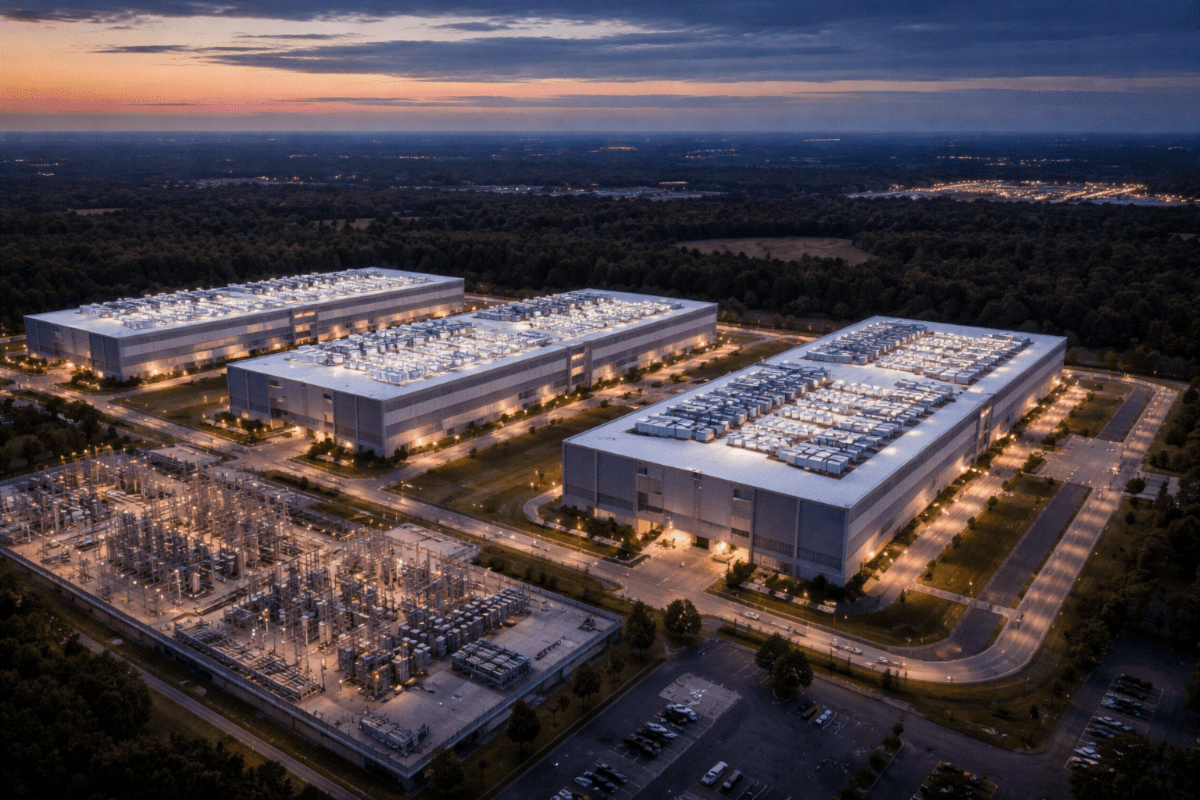
Source: AI Tool Discovery, “Hyperscalers Explained."
For more than a decade, U.S. electricity demand barely moved. Efficiency gains offset population growth and a shrinking industrial base, so utilities planned around a flat curve. Artificial intelligence (AI) has broken that pattern. AI models run on computing power, and computing power runs on electricity. Data centers are the hub of computing power, so as more data centers are built, more electricity is needed. The country produces enough power in aggregate to run today's economy. That is not the same as having enough power, in the right place, at the right reliability, for the next generation of hyperscale data centers. This is the gap at the center of the AI power story, and what happens next to close it will shape utility bills, investment choices, and where the AI infrastructure actually gets built.
How Is Power Defined?
Power Demand for Data Centers Set to Triple from 2020-2030
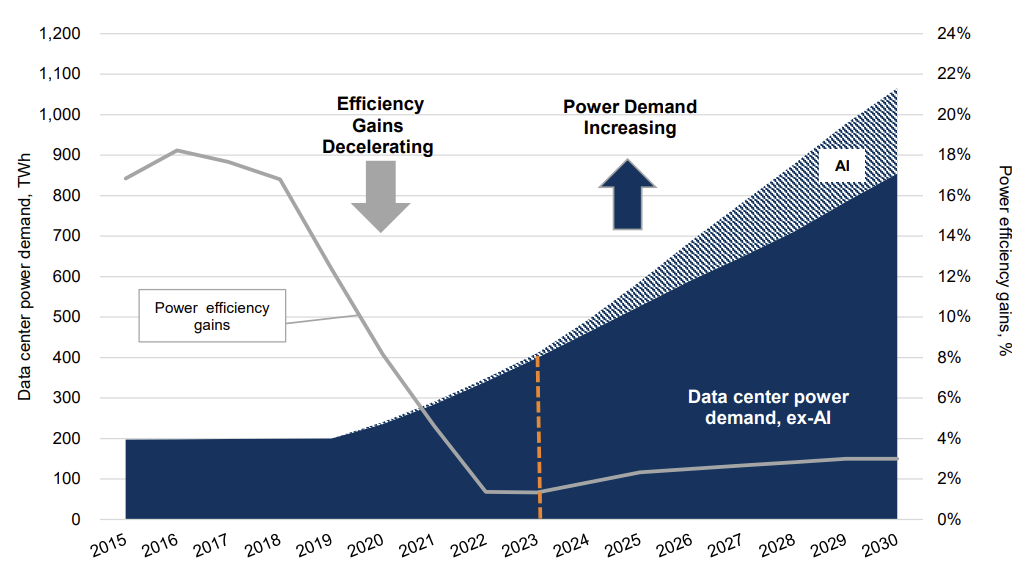
Data center electricity consumption, TWh (LHS) and 3-year rolling average power efficiency gains yoy, % (RHS). Source: Masanet et al. (2020), Cisco, IEA, Goldman Sachs Global Investment Research
Power is measured in watts (W), with kilowatts (kW), megawatts (MW), gigawatts (GW), and terawatts (TW) representing increasingly larger scales. The U.S. power grid has about 1,100 GW of capacity. Watts measure the rate at which electricity is used or generated, while watt-hours measure the total energy consumed over time. Homes and appliances are generally measured in kilowatts, power plants in megawatts or gigawatts, and national or global energy systems in gigawatts or terawatts. Terawatt-hours (TWh), as referenced above, are commonly used to track electricity generation and consumption across countries and the global economy.
When it comes to AI and data centers, J.P. Morgan's 2026 energy research notes that OpenAI alone has announced partnerships requiring roughly 30.5 gigawatts of new power capacity.1 This is about three-quarters of the nuclear power the U.S. built in any five-year stretch of its original nuclear construction era. That figure reflects announced deals, not operating demand, and remains subject to financing, permitting, and equipment availability.
Interconnection queues confirm it. In September 2025, ERCOT (Electric Reliability Council of Texas), the Texas grid operator, was tracking about 189 gigawatts of proposed large-load connections, up from 56 gigawatts a year earlier. By June 2026, that figure had climbed past 438 gigawatts, with nearly 89% tied to data centers. That total dwarfs Texas's current peak demand, and much of it is speculative. Developers file overlapping and early-stage requests, so many of the projects will be delayed, shrunk, or canceled. Even discounted for that noise, the volume is why grid planners can no longer rely on the old playbook.
Globally, the International Energy Agency projects data center electricity use will more than double by 2030, to roughly 945 terawatt-hours, with AI-optimized data centers alone more than quadrupling their consumption over that stretch.
Data Centers Estimated to Contribute 37.5% to Annual Growth of U.S. Power Demand by 2030
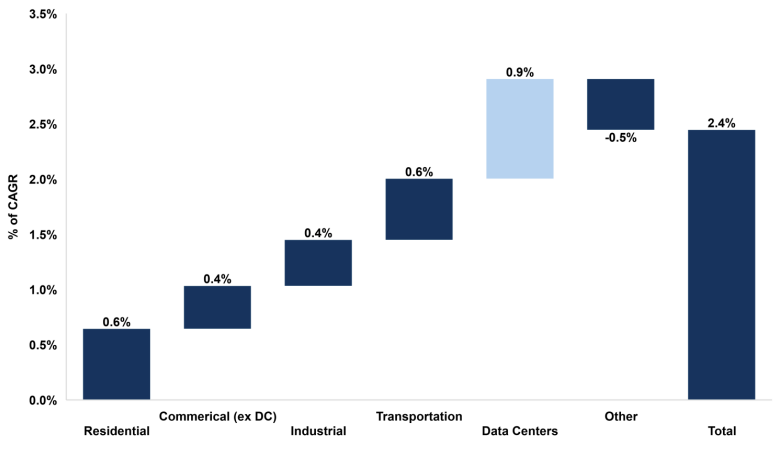
Composition of U.S. power demand CACR, 2022-2030, %. Source: Goldman Sachs Global Investment Research, EIA
Efficiency is improving, but it is not winning the race. Chips, servers, and AI models are all getting more efficient. Historically, though, when a technology gets cheaper to run, people use more of it, not less. Larger models, more training runs, and broader adoption are outpacing the savings.
Where the Pressure Is Concentrated
Overall Estimated Net Capacity Additions Through 2030
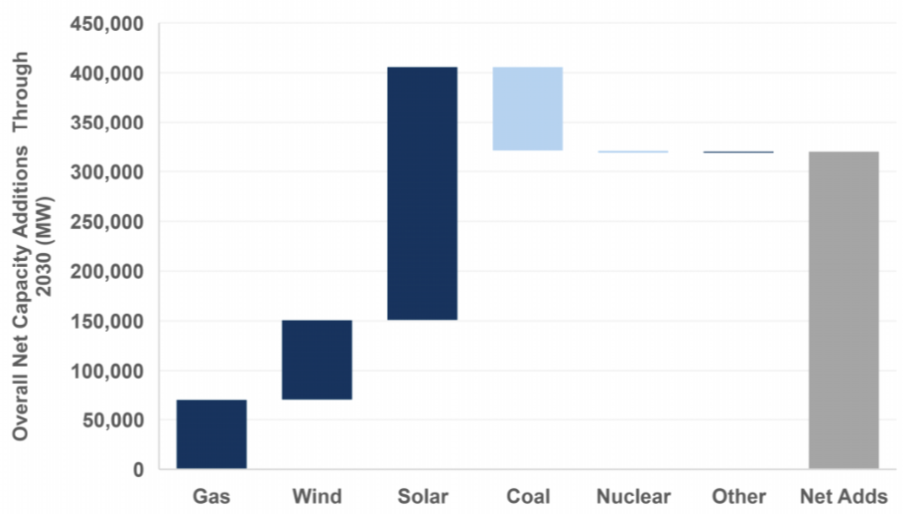
Overall net capacity additions through 2030 by source, MW. Source: Goldman Sachs Global Investment Research, EIA
What's Possible: Five Ways to Close the Gap
No single source solves closing the energy gap. The buildout will lean on a combination, and each option comes with its own tradeoffs.
Source: Barclays, Wood Mackenzie, IEA, Bloomberg News
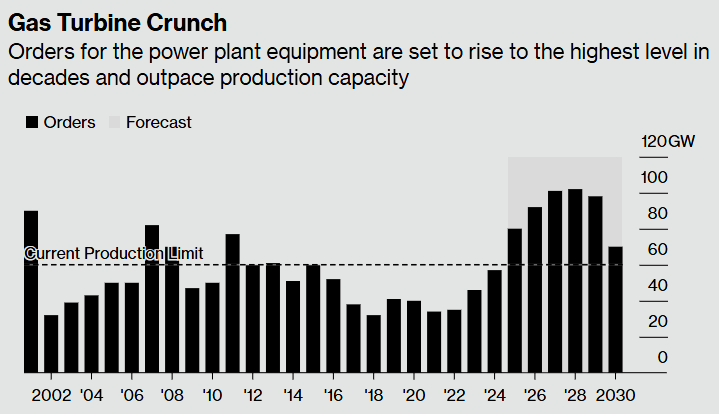
Natural gas is the near-term bridge. Combined-cycle plants operate around the clock and cost less to build than nuclear plants. But the market for large turbines is dominated by a handful of manufacturers, GE Vernova, Siemens Energy, and Mitsubishi Power among them, and demand has outrun supply. Lead times now stretch several years, and some suppliers require large deposits just to hold a manufacturing slot.
Nuclear power offers what AI operators want most: constant, reliable, low-emission output. Microsoft is backing the restart of Three Mile Island Unit 1. Meta has a long-term deal tied to the Clinton Clean Energy Center. Amazon has pursued both existing nuclear generation and next-generation reactor technology. These are real commitments, but restarting a retired reactor, let alone building a new one, takes years. Nuclear's contribution will matter more toward the end of the decade than it does today.
Small modular reactors (SMRs) hold real long-term promise but real near-term cost problems. First-of-a-kind SMR projects are estimated to cost $150 to $400 per megawatt-hour, several times the $55 to $85 cost of conventional gas generation. Costs could fall as designs standardize, but most current projects still depend on government support and unproven technology.
Solar paired with storage can be deployed fast, which matters when grid connections are backed up for years. But a system built to deliver continuous, always-on power costs meaningfully more than one that only needs to produce when the sun shines. One detailed reconstruction of a widely cited solar-and-storage cost analysis found that a truly baseload-equivalent system costs roughly $200 to $210 per megawatt-hour under U.S.-specific assumptions, well above the cost of an all-gas system.
Behind-the-meter power lets developers build around the grid instead of waiting for it. Roughly 30% of planned U.S. data center capacity is reportedly considering some form of onsite generation, most of it gas-fired. It won't replace the grid connection entirely, but it can keep a project moving while the surrounding infrastructure catches up.
Someone Has to Pay, and States Are Rewriting the Rules
When a data center connects to the grid, the utility often has to build new substations, transmission lines, and generation to serve it. If those costs land in the general rate base, households may end up paying part of the bill, a dynamic that becomes contentious fast if the project is delayed, underdelivers, or leaves the region early.
States are responding. Texas has created a new review process for very large load requests and set specific requirements for facilities seeking 75 megawatts or more, intended to separate credible projects from speculative ones. Other states are moving toward similar principles: minimum payment commitments, protections for existing customers if a project falls through, and the ability to curtail large loads during grid emergencies. This will keep playing out state by state and rate case by rate case, and the resulting rules will influence not just household bills but where technology companies choose to build next.
Other states like New York and Maine are looking to freeze all new data center construction due to rising electricity costs for residents, environmental concerns, and resource shortages.2
What's Happening Now
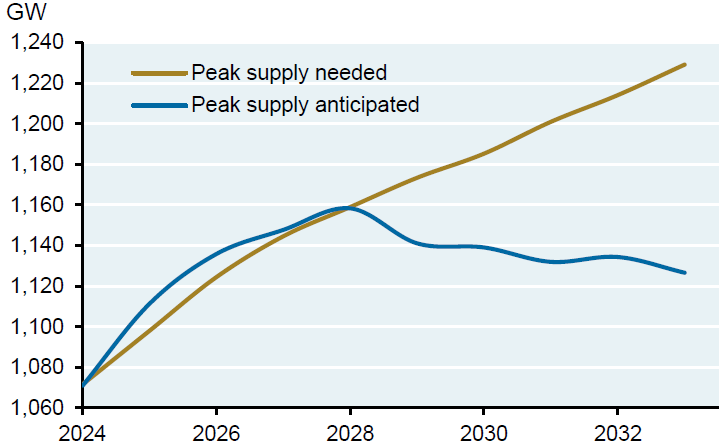
Projections of the U.S. Power Supply-Demand Gap
Source: NERC, Schneider Electric, 2025
The response is already underway. Utilities are raising capital spending plans. Power producers are building new gas capacity and working to restart nuclear plants. Technology companies are signing long-term power agreements, investing directly in generation, and exploring onsite power. Grid operators are rewriting how they screen large-load applications, and equipment manufacturers are expanding production to work through years-long backlogs. At the same time, local pushback over land use, water use, noise, and electricity prices is already contributing to project delays and cancellations, which is why today's queue of announced projects is best read as a range of outcomes, rather than a fixed schedule.
What Else Could Happen
A few things could shift the picture from here. Announced demand could come in lower than advertised, as projects get delayed, downsized, relocated, or made obsolete by efficiency gains. Data center demand could also become more flexible, with some computing workloads shifted to times or places where power is more abundant in exchange for faster grid connections. Technology companies, flush with capital and long-term horizons, may increasingly become power developers in their own right rather than simply large customers. And policy could move the timeline in either direction, since faster permitting for plants, pipelines, and transmission would help close the gap, though permitting reform remains politically difficult.
What We're Watching
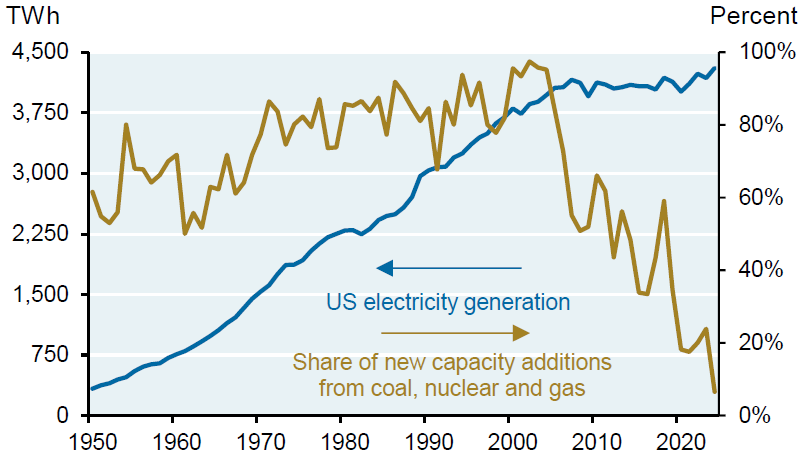
Generation and Capacity Additions Since 1950
Source: EIA, JPMAM, 2025
A handful of signals will show whether supply is starting to catch up with demand:
- How many announced projects actually secure financing and reach construction, rather than just filing an interconnection request?
- Do states continue to impose roadblocks and try to prevent data centers from being built?
- The pace and regulatory treatment of utility capital spending.
- Capacity and wholesale power prices tend to move first when supply gets tight.
- Turbine orders and pipeline development, since new gas capacity is only as fast as its equipment.
- Whether nuclear restarts and SMR projects stay on budget and schedule.
- Progress on interconnection and transmission reform, since new generation is only useful if it can actually reach the grid.
The Bottom Line
The United States can build the power needed to support a much larger AI industry. It's just not an immediate, cheap, or uncoordinated investment. The core problem is not a permanent shortage of energy resources; it is a mismatch in speed. AI demand is arriving in months, while power plants, transmission lines, and substations take years. Natural gas will carry most of the near-term load, renewables and storage will keep expanding, and nuclear will matter more as the decade progresses. How quickly the gap closes depends on execution: utilities have to be built, regulators have to approve, manufacturers have to deliver, and technology companies have to prove their demand projections are commitments rather than placeholders. The AI boom was never just a story about software and chips; it is an energy story too. The pace of AI development will depend as much on what gets plugged into the grid as on what gets written in code.
Principle Wealth