When Today Matters More Than Tomorrow:
A Society Addicted to Now
The Market Isn’t Broken, Our Time Horizon Is

Source: @ezgicodes/x.com
Temporal discounting, the tendency to overvalue the present at the expense of the future, is one of our most consequential evolutionary inheritances. It made sense when survival depended on seizing what was available now. But in a world where long-term planning is not only possible but necessary, that same instinct works against us. We optimize for the immediate: quick wins, fast returns, fleeting satisfaction. And in doing so, we systematically underinvest in the things that compound, resilience, durability, and outcomes that only reveal their value with time.
The Mechanics of Short-Term Thinking
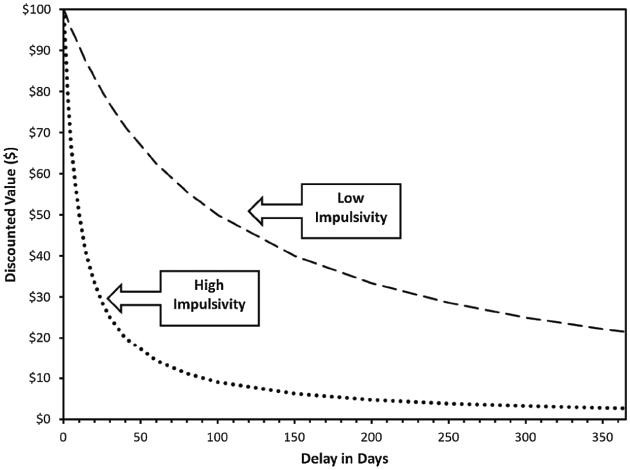
Source: MacKillop (2013). Prototypic hyperbolic delayed reward discounting curves reflecting the discounted subjective value of $100 delayed from 1 day to 1 year The curves reflect the points at which the smaller immediate reward is equal in value to the $100 delayed reward. For example, at a delay of 100 days, $100 has lost ∼50% of its nominal value for the low impulsivity profile and ∼90% of its nominal value for the high impulsivity profile.
At its core, temporal discounting reflects how the brain processes reward. Immediate outcomes activate powerful reinforcement loops, while future consequences feel abstract and emotionally distant. Technology has dramatically amplified this effect. Social media, on-demand entertainment, frictionless spending, and real-time feedback systems condition behavior around instant response and rapid payoff. The cost is not merely distraction; it is a systematic undervaluing of the future.
This bias manifests subtly at first…skipping exercise, postponing savings, deferring difficult conversations, but scales aggressively at the societal level. When millions of individuals discount the future simultaneously, the aggregate outcomes compound in the wrong direction.
The Brain Game
Source: Pikovit, iStock
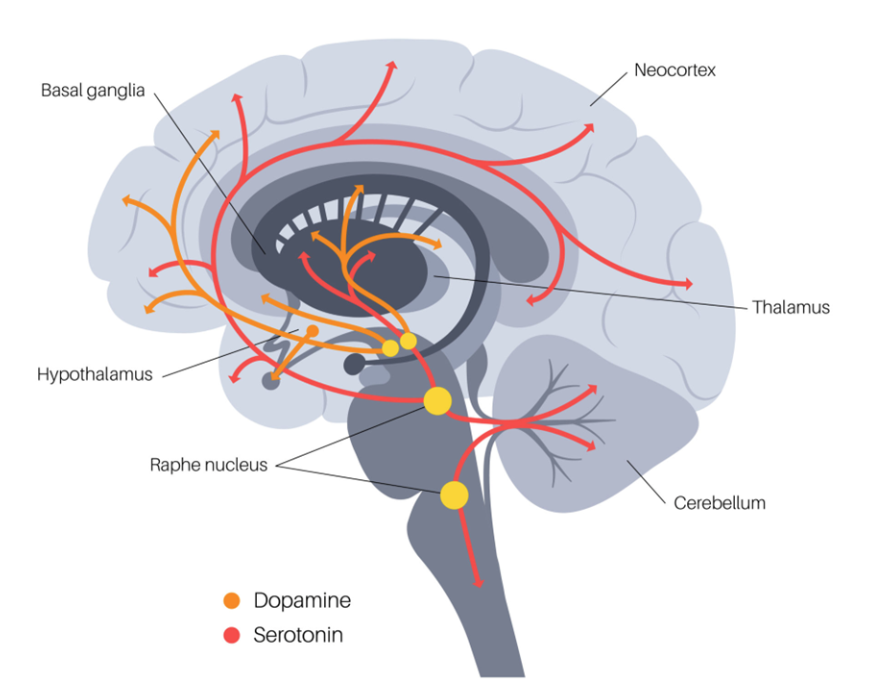
The diagram above visualizes the neurological tension at the heart of temporal discounting. The orange pathways show dopamine, the neurotransmitter associated with reward, motivation, and immediate reinforcement, flowing through regions like the basal ganglia and hypothalamus; areas that drive habit formation, impulse, and action. These circuits are fast, powerful, and evolutionarily old, optimized to prioritize what feels good now.
In contrast, the red pathways show serotonin, which is more closely tied to mood regulation, patience, impulse control, and long-term stability, with stronger integration into higher-order regions like the neocortex. Temporal discounting makes it self-known when dopamine-driven systems dominate decision-making while serotonin-linked, deliberative systems are overridden or ignored. Modern environments engineered for constant stimulation repeatedly activate these dopamine loops, biasing behavior toward immediacy and away from future consequences.
In effect, the brain’s short-term reward circuitry increasingly outvotes its long-term planning apparatus, turning a once-useful survival mechanism into a structurally counterproductive force in modern society and financial decision-making.
Societal Consequences: From Institutions to Individuals
Short-termism has reshaped how institutions behave. Corporations face quarterly earnings pressure that discourages long-horizon investment in research, workforce development, and durable infrastructure. Political systems increasingly reward policies with immediate visibility rather than those whose benefits accrue over decades. Public discourse favors outrage and speed over depth and deliberation.
At the individual level, the same pattern repeats. Health outcomes suffer as preventive behaviors lose out to convenience. Personal finances skew toward consumption rather than savings. Career decisions optimize for near-term compensation or status rather than skill accumulation and optionality. Over time, these choices reduce resilience throughout the realms of financial, physical, and psychological.
The paradox is that many of the most meaningful human gains, health, wealth, trust, expertise, are products of slow accumulation. Temporal discounting systematically undermines the very processes that generate long-term well-being.
Investors as a Case Study in Discounting
Nowhere is the tension between short-term reward and long-term value clearer than in investing. Markets increasingly reflect rapid narrative shifts, momentum chasing, and performance measurement over compressed time frames. Investors often overreact to near-term data and headlines while underweighting structural trends, business fundamentals, and the mathematics of compounding.
This behavior creates two reinforcing effects. First, volatility increases as capital chases immediacy rather than fundamentals. Second, patient capital becomes rarer, even though it is precisely patience that has historically generated outsized returns. Long-term investors are not rewarded because the future is predictable; they are rewarded because most participants cannot tolerate waiting.
Over decades, this collective impatience leads to misallocation, underinvestment in productive assets and overinvestment in speculative or attention-driven opportunities. The irony is that markets still reward long-term discipline, but only for those willing to act against the prevailing psychological current.
Relearning the Value of the Future

Source: Stanford Marshmallow Test experiment, Walter Mischel / Stanford University
One of the earliest and most famous demonstrations of temporal discounting came from the marshmallow study, a series of experiments in the late 1960s that tested children’s ability to delay gratification. Participants were given a simple choice: eat one marshmallow now, or wait and receive two later. Some waited. Many didn’t. What made the study enduring wasn’t the candy, it was what followed. Children who successfully delayed gratification tended, on average, to show better long-term outcomes across measures like academic performance, health, and financial stability. The lesson wasn’t that willpower alone determines destiny, but that the ability to value future rewards, even abstract ones, confers a compounding advantage over time.
In today’s environment, however, adults are surrounded by forces that actively undermine this skill. Where the marshmallow once sat quietly on a table, modern life offers an endless stream of digital marshmallows, notifications, trades, purchases, and opinions, each engineered to be consumed immediately. The result is that many adults, especially investors, face the same test daily, but under far more intense conditions and with far higher stakes.
Societies that build long-term thinking into their institutions and incentives tend to produce more durable outcomes; Japan's post-war industrial policy and Norway's Sovereign Wealth Fund are two examples. The same logic applies to individuals. Those who learn to think in terms of compounding, across capital, habits, relationships, and knowledge, tend to accumulate advantages that short-term thinkers never see coming.
The challenge of the modern era is not access to information or opportunity. It is the discipline to delay gratification in a world engineered to eliminate waiting. The future is still where the largest rewards reside, but only for those willing to value it appropriately.
In an age obsessed with immediacy, long-term thinking has become a competitive edge.
Principle Wealth